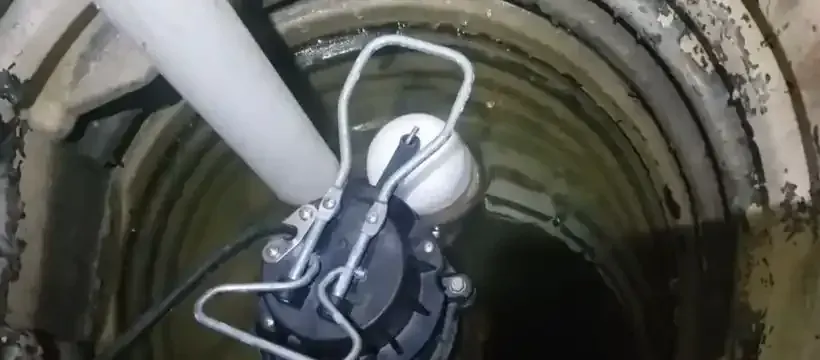
Submersible or pedestal
A submersible pump sits in the water at the bottom of the pit with its motor sealed. A pedestal pump has its motor mounted above the pit on a shaft. Submersibles are quieter, handle more water and take up less room. Pedestal pumps are cheaper and easier to service, but they are louder and less powerful.
For most basements where water is a real concern, a submersible pump is the better choice. It is cooled by the water around it, it does not need the pit to be big, and it stays out of sight.
What to look at when choosing
| Feature | What it does | Why it matters |
|---|---|---|
| Horsepower and flow. | Sets how much water moves per minute at your lift height. | Undersized pumps cannot keep up in a storm. |
| Switch type. | A float or electronic sensor starts the pump. | A stuck float is the most common failure. |
| Cast iron or thermoplastic. | The housing material. | Cast iron sheds heat better. |
| Vortex or screened inlet. | Handles fine debris. | Prevents clogging. |
| Check valve. | Stops water flowing back into the pit. | Protects the pump from short cycling. |
Lift height is how far the water must be pushed, from the pit up to where the discharge exits. A higher lift reduces flow. A pump should be chosen using its flow at your lift, not its headline number.
A proper installation, step by step
- Prepare the pit. It should be clean, level and sized for the pump. A gravel base keeps silt from reaching the intake.
- Set the pump and the float. The float must move freely and not touch the walls or the discharge pipe.
- Install the discharge pipe and check valve. A weep hole in the pipe above the pump prevents an air lock. The check valve goes above that.
- Run the discharge outside. Route the pipe to a place where water drains away from the house and does not refreeze at the outlet.
- Seal the pit lid. A sealed lid keeps humidity and debris out of the pit.
- Test it. Pour water into the pit until the float lifts, and confirm the pump starts and empties it.
Discharge line and backup power
The discharge line is where many installations go wrong. If it ends too close to the foundation, the water returns to the pit and the pump cycles endlessly. If it freezes, the pump strains and may burn out. Slope it away, and keep the outlet clear in winter.
Storms often cut power. A battery backup pump on a separate float keeps the basement safe when the main pump has no electricity. Check the battery regularly and replace it on schedule. See sump pump installation and repair for the options we install.
Maintenance that keeps a pump working
A sump pump sits unused for weeks and then has to work hard on the worst day. A twice-yearly routine keeps it ready.
- Unplug the pump and lift it out of the pit, if it is easy to do, then clean the intake screen.
- Remove silt and debris from the bottom of the pit.
- Check that the float moves freely and does not touch the sides.
- Pour a bucket of water into the pit and watch the pump start and stop.
- Check the discharge line outside for blockages, ice or damage.
- Test the battery backup, if you have one, and replace the battery on schedule.
If the pump is more than several years old and has run hard, replace it before the wet season. A planned swap costs less than a flooded basement.
Noises and what they mean
A pump that rattles may have debris in the impeller. One that screams or grinds has a worn bearing. A gurgling sound as it shuts off may be the check valve letting water drain back. A pump that cycles every few seconds is hunting between the float levels, and that usually means the check valve has failed or the pit is too small.
Sizing the pit and the pump together
A pit that is too small makes the pump cycle on and off often, and short cycling wears out the motor. A common residential pit is eighteen inches across and about two feet deep, but houses with heavy inflow benefit from a larger one. Larger pits give the float more room and let the pump rest between runs.
Check that the float has clear travel. A float that rubs the pit wall or hangs on the discharge pipe fails to start the pump, which is the usual cause of a flooded basement with a working pump. A vertical float switch or an electronic sensor avoids that problem.
Plainfield note: what the City says and what Ida showed
The City of Plainfield's homeowner manual tells residents to check that the sump pump float moves up and down freely, and it warns that many basements are flooded because of defective gutters and downspouts. The manual does not list sump pumps among permit items, and it advises calling the Building Department to confirm. The Construction Office can be reached at 908-226-2665.
In September 2021, North Plainfield's borough press release described flood damage after Ida and a fire department list of residents needing basement pump-outs. Pumps are not a theory here. They are what stands between a storm and a flooded basement, and a backup is the difference between a bad night and a bad month.
Where the discharge should and should not go
- Away from the foundation, onto ground that slopes away from the house.
- Not onto a neighbor's property or a shared walkway where it can freeze and create ice.
- Not into the sanitary sewer. Sump water generally does not belong there.
- Into a dry well or a drainage swale where one exists and is allowed.
Rules for where sump water can go differ by municipality, so confirm before you route the line. If you are planning a full water control project, basement waterproofing covers the wider picture. We work in Plainfield, North Plainfield and South Plainfield.
Submersible sump pump questions
That depends on the water inflow and the lift height. A pump chosen by its flow at your lift is more reliable than one chosen by horsepower alone.
Many last several years, and heavy use shortens that. Test it twice a year and replace an aging pump before storm season.
A stuck float, a failed check valve, a high water table or a discharge line that returns water to the pit.
The City's homeowner manual does not list sump pumps among permit items and suggests calling the Building Department to confirm at 908-226-2665.
If your basement has flooded in storms that also knocked out power, yes.