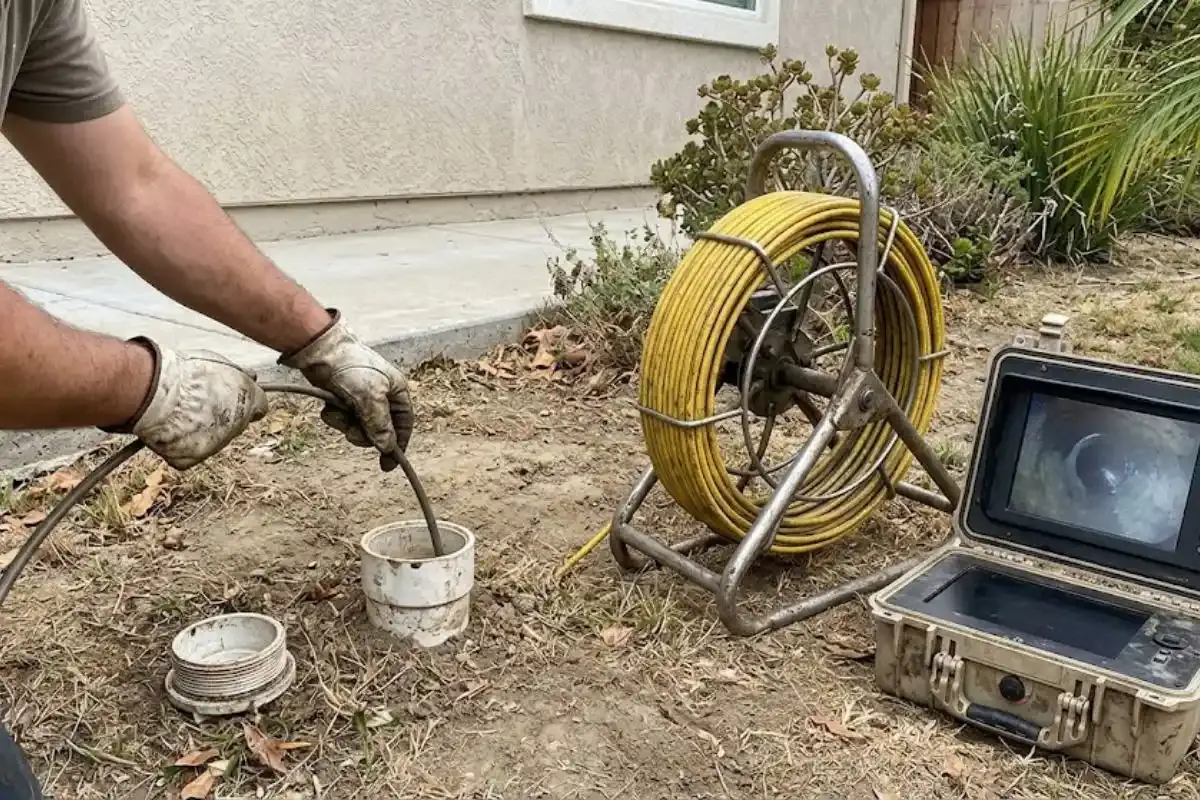
What a sewer camera inspection shows
A waterproof camera on a flexible rod travels from your cleanout toward the street. It records the pipe material, the joints, cracks, roots, bellies where water pools, offsets and any buildup. A locator on the camera head marks the surface above each problem and measures its distance from the entry point.
Without that picture, repairs are guesses. With it, you can tell a clog from a cracked pipe, a short bad section from a failed run and a cosmetic scale problem from a structural one.
When a camera inspection is worth it
Repeat clogs
If the main line clogs again within months, the camera shows the cause instead of the symptom.
Buying an older house
A scope before closing reveals a failed lateral that a home inspection cannot see.
Gurgling or odors
Sounds and smells from drains often point to a belly or a cracked joint.
After a backup
A recording documents the pipe's condition and what a cleaning did or did not fix.
If a line is already backed up, we clear it first. Our drain cleaning and hydro jetting pages explain how. A camera in a flooded pipe shows very little.
What you receive
- A video recording of the full run, so you can watch it or send it to an insurer, seller or contractor.
- Marked locations and depths for each defect we find.
- A plain-English summary of what we saw, in order of how serious it is.
- A recommendation that fits the finding, from no action to cleaning, lining, spot repair or replacement.
We separate what is urgent from what is only worth watching. Many pipes show root hairs or light scale and can wait. Others show a collapsed section that cannot.
Plainfield note: what old laterals look like on camera
Plainfield's growth from about 5,100 residents in 1870 to more than 34,000 by 1930 means many laterals date from a century or more ago. The Crescent Area Historic District alone has 111 contributing buildings, most built between 1870 and 1900. Pipes that old are commonly clay with loose joints or cast iron with scale.
On camera, clay shows offset hubs and root intrusion. Cast iron shows flaking, thinned walls and cracks along the bottom of the pipe. A mix of both, with plastic repairs in between, is also common. Each reads differently, and we explain what yours means for your next step.
How a scope fits with repairs
A camera does not repair anything. It tells you which repair, if any, fits. If the recording shows a short bad section, a spot repair may be enough. If cracks run along a long stretch, lining may work. If the pipe has collapsed, replacement is the honest answer. Our sewer line repair page compares those options.
Camera work is also useful before an expensive project. Before a landscaper plants a tree or a contractor pours a patio, a scope shows where the lateral runs and what shape it is in.
What affects the price of a sewer camera inspection
- Cleanout access.A clean, reachable cleanout makes the scope faster.
- Line length and bends.Longer runs and tight bends take more time.
- Need to clear the line first.A blocked pipe has to be cleared before the camera can see it.
- Locating and marking.Surface marking of each defect adds a step.
- Report and recording.The cost of a written summary and video copy depends on the scope.
Call (908) 357-1542 and we will give you a clear price before we start.
Want to know what is in your sewer line?
Tell us why you want it scoped and we will plan the visit.
Where we scope sewer lines
We run sewer cameras across Plainfield, including the 07060, 07062 and 07063 ZIP codes, and in Scotch Plains, North Plainfield and Piscataway. Home buyers and sellers can book around an inspection deadline.
Sewer camera inspection questions
A typical residential scope takes under an hour once we have access. Long runs, bends or a line that needs clearing first take longer.
A cleanout is the easiest access point. Without one, we can sometimes go through a pulled toilet or a roof vent. We can also install a cleanout if the line has none.
A camera on a flexible rod is gentle on sound pipe. In badly deteriorated pipe we go carefully and stop if we see a risk of collapse.
A dated recording is useful documentation. Whether your policy covers the damage depends on the policy, so ask your carrier.
For an older house, a scope is a sensible check. It reveals problems a standard inspection cannot see.
Yes. We explain the options that fit the finding and quote the one you choose.